Galveston family shares stories of enslaved ancestors and success that followed ahead of Juneteenth


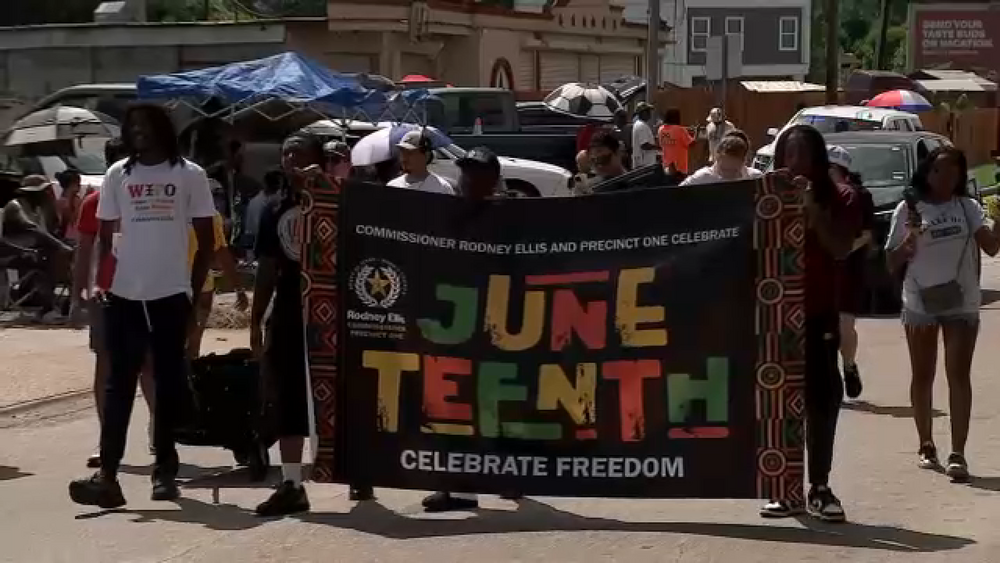
GALVESTON, Texas (KTRK) -- Juneteenth marks a pivotal part of our nation's history.
For a local family, it's also a time to reflect on their past: the journey of their enslaved ancestors and the success that followed.
"My great-grandfather was a 5-year-old when his family came in 1865," Diane Henderson Moore said.
On June 19, 1865, Union soldiers would arrive in Galveston to deliver the news that the last of the enslaved were free. This came nearly two and a half years after President Abraham Lincoln enacted the Emancipation Proclamation.
"Prior to that (June 19), the ancestors of mine who came were enslaved just across Galveston Bay a few miles from here in Port Bolivar. And they came here when emancipation came," added June Collins Pulliam.
Roy Collins, June Collins Pulliam, and Henderson Moore are the great-great-grandchildren of Horace A. Scull and Emily Scull.
"They immediately came to Galveston once emancipation came. There was a good reason for that, and that's because it was a place where the federal troops had arrived, and you know it was going to affect change in a much more direct way rather than simply waiting for the society to adapt to itself," Collins said.
Adapting to the new freedom was next. The family says the Scull's would carve out their own path of success in Galveston with their children, including Ralph Albert Scull.
Ralph, their great-grandfather, was 5 years old when slavery was abolished.
"I know that one of the things that happened immediately after slavery ended was that schools had to be set up as well," Collins Pulliam said. "He went to all the schools that were available for him here, and when he had obtained all the education he could, he went away to Wilberforce University and got his teaching credentials."
Juneteenth, for this family, is a reminder of the fight their ancestors had to endure.
"For me, it means the beginning of freedom and beginning of other opportunities," Henderson Moore said.
Collins pointed to the historical meaning of the day.
"Personally, for me, it's really an important remembrance of a very pivotal time in history," he said. "Enslaved people finally were able to realize the emancipation that was anticipated some years before, that had been prayed for generations before."
As Ralph Scull grew up, he documented what life was like in Galveston after Juneteenth.
"He kept records of how even Juneteenth was celebrated and aspects of such as there was a cadet band that was formed by current and former military personnel who were in Galveston, essentially African American men, that were very pivotal in the social aspect of Galveston," Collins said. "They were in demand across ethnicities for major events. There are stories in the newspapers about my great-grandfather and his sister in successive years from 1885 and then 1888, each of them having an opportunity to participate in the Emancipation Day celebrations and reading the Emancipation Proclamation."
Roy and June's mother, Izola Fedford Collins, published a book, "Island of Color: Where Juneteenth Started." The book details the stories of Galveston from 1865 to the early 2000s.
"I'm fortunate enough to say that many of my ancestors were part of the change that came into Galveston, establishing many institutions, whether it be educational, religious, business, cultural, social, otherwise," Collins added.
One of those institutions was Reedy Chapel AME Church. A former meeting place for the enslaved, the church would remain a safe place even after the end of slavery.
It's a congregation this family is still part of today.
"So Reedy becomes a very important part of the family's history. As you look at some of the cornerstones of the church, you can actually see names recited of my great-great-grandfather, Horace Scull, and his son, Ralph Scull. They were essentially in leadership, obviously, in church trustees at the time, going into the late 1800s. In terms of involvement, my great-grandfather, Ralph Albert Scull, was a minister, and was involved at this church, heading up Christian education."
A lineage of history with stories they hope can help generations to come.
For news updates, follow Brandon Hamilton on Facebook, X and Instagram.