'If we be silent, that's what they want': The Afghan women's soccer team makes home in Houston


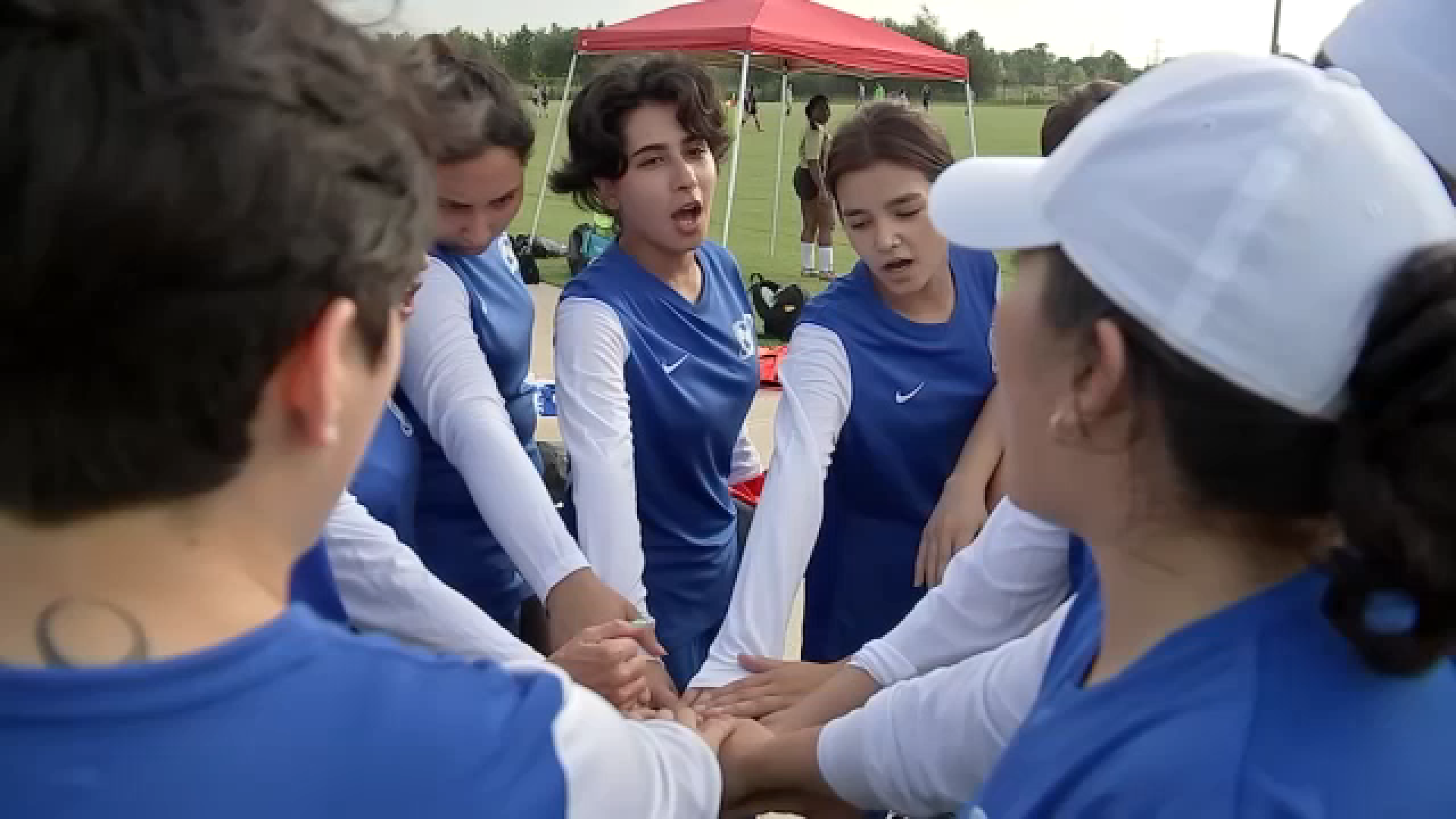
HOUSTON, Texas (KTRK) -- The word goal has multiple meanings: there's making it into the net, and there's envisioning doing so.
"If you fight for your right, one day you will achieve the things you want," Sodaba Khinjani said. "If I be scared or if other girls be scared, if we be silent, that's what they want, that is what they want from us, and I will not allow that."
For these women, just being on the field is a form of protest. Existing is a revolution.
They are soccer players from Afghanistan, frantically flown out of the country after the U.S. withdrawal and Taliban takeover five years ago.
Most came here alone, with just the clothes they were wearing.
Zed Sultani was 16, born years after the 9/11 attacks and the U.S. invasion of Afghanistan.
When the Taliban seized control once again, she said she received death threats.
"They're always saying, 'Girl is just for washing dishes, cleaning the house, and getting married, nothing else,'" she said.
Across town, in a small southwest Houston apartment, roommates Rabia Yaqobi and Zahra Hasani struggle to pay rent.
Hasani works overnight at a warehouse.
Yaqobi works in the cafeteria at the University of Houston.
"Sometimes 4 a.m. finish, sometimes 6 a.m. finish, sometimes 7 a.m. finish," explained Hasani.
"Here, just me. Nobody to support me. Nobody help me to pay for homes, not pay for car," Yaqobi said.
FIFA, international soccer's governing body, helped the women get out of Afghanistan and got them green cards.
But after the women got to Houston, FIFA handed them off to already overwhelmed local aid groups.
They said they were denied access to FIFA training camps and weren't invited to join the newly formed Afghan women's refugee team, made up of women who had been relocated to Europe and Australia.
For two years, they didn't play soccer.

Khinjani is the oldest on the team.
She's now 28 years old, and while she was a dentist in Afghanistan, her degrees and experience didn't transfer over.
After studying for and passing multiple exams, she's now working as a dental nurse.
"I will show them, this was not the end of the story. Your behavior is not making us weak. This was our strength," she said. "That's why I don't want to forget it."
Khinjani can't forget what it was like leaving her country.
"I said, 'I am footballer,' and the rest of the women were like, 'Shh, don't say that, they will kill you over here, don't.' They used the guns in their hands, and they beat us with the back of the gun on the backside and said, 'Go home,'" she said.
Her brother was an interpreter for the U.S. Army.
She said he was captured after U.S. forces left.
"I never forget that moment that I see his dead body, and his upper body was separate from his lower body, and here the side of his face was gone," Khinjani said.
Rachel Fabre now coaches the group of women.
"I feel like this team is as if you planted a tree, a young tree, and it was just stuck in the ground, and then you didn't do anything to it for like two years, opposed to if you just kind of added a little water here and there," Fabre said.
The women are now part of the Houston Women's Soccer Association.
Their team is called the Houston Shine.
"I try to get any young female I coach to envision what they can become, whether it be as a player, a leader, what they want to be one day, and go after it," Fabre said.
But their futures are still uncertain, in a country led by an administration that is restricting immigration.
Their families are still in Afghanistan.
"I love the United States because this is the country that saved our lives. I feel like home, but still I miss my family over there," Khinjani said. "I know we are in the first world, but still we are struggling, so if we don't speak, we just keep our voice down, nobody will care about us."